
The Breath Health Code : Cure Fever, Headache, Cold, Digestion & More Using only Your Breath
Imagine waking up at 11:00 PM feeling the unmistakable heat of a sudden fever coming on. The local pharmacy is long closed, you prefer to avoid taking heavy pills for a symptom that might naturally pass by morning, and you find yourself lying awake wondering if there is any immediate action you can take to assist your body right now.
Or perhaps you are dealing with a lingering cold — the kind that never fully resolves, leaving your head heavy and your energy completely drained. Ancient Swarodaya texts dedicate extensive, detailed chapters to these exact physical scenarios, outlining practical breath healing techniques. These tools are not vague wellness suggestions; they represent testable, physical interventions mapped explicitly to recurring symptoms.
While these methods are never intended to replace professional medical care when advanced treatment is required, mastering basic breath healing techniques hands you an empowering, zero-cost, first-response tool kit. Here is how you can use your breath’s built-in regulatory channels to target six common physical ailments.
Why Breath Healing Techniques Work: The Swara Framework for Disease
Classical Swara Sadhana text lineages advance a straightforward diagnostic premise: the vast majority of routine, common physical imbalances originate from a prolonged disruption in your natural nasal cycle. When your respiration runs counter to your body’s current environmental demands — such as your right nostril remaining dominant when your nervous system desperately requires cooling, left-sided rest — it creates an internal vulnerability. The texts refer to this chronic reversal as viparita swara.
The therapeutic fix operates on symmetric logic: manually realign your breath pattern, and you rapidly shift your internal environment. Heat-based ailments like fevers, localized inflammation, and sharp headaches respond smoothly to the cooling, parasympathetic Ida channel accessed via the left nostril. Conversely, cold, damp, and stagnant issues like sinus congestion, chronic coughs, and sluggish digestion respond to the heating, sympathetic Pingala energy of the right nostril.
This models perfectly onto our contemporary understanding of the autonomic nervous system. Deliberately isolating your breath flow doesn’t merely track your current state of wellness — it serves as an active, mechanical input to alter core metrics like core temperature, heart rate variability, and metabolic output.
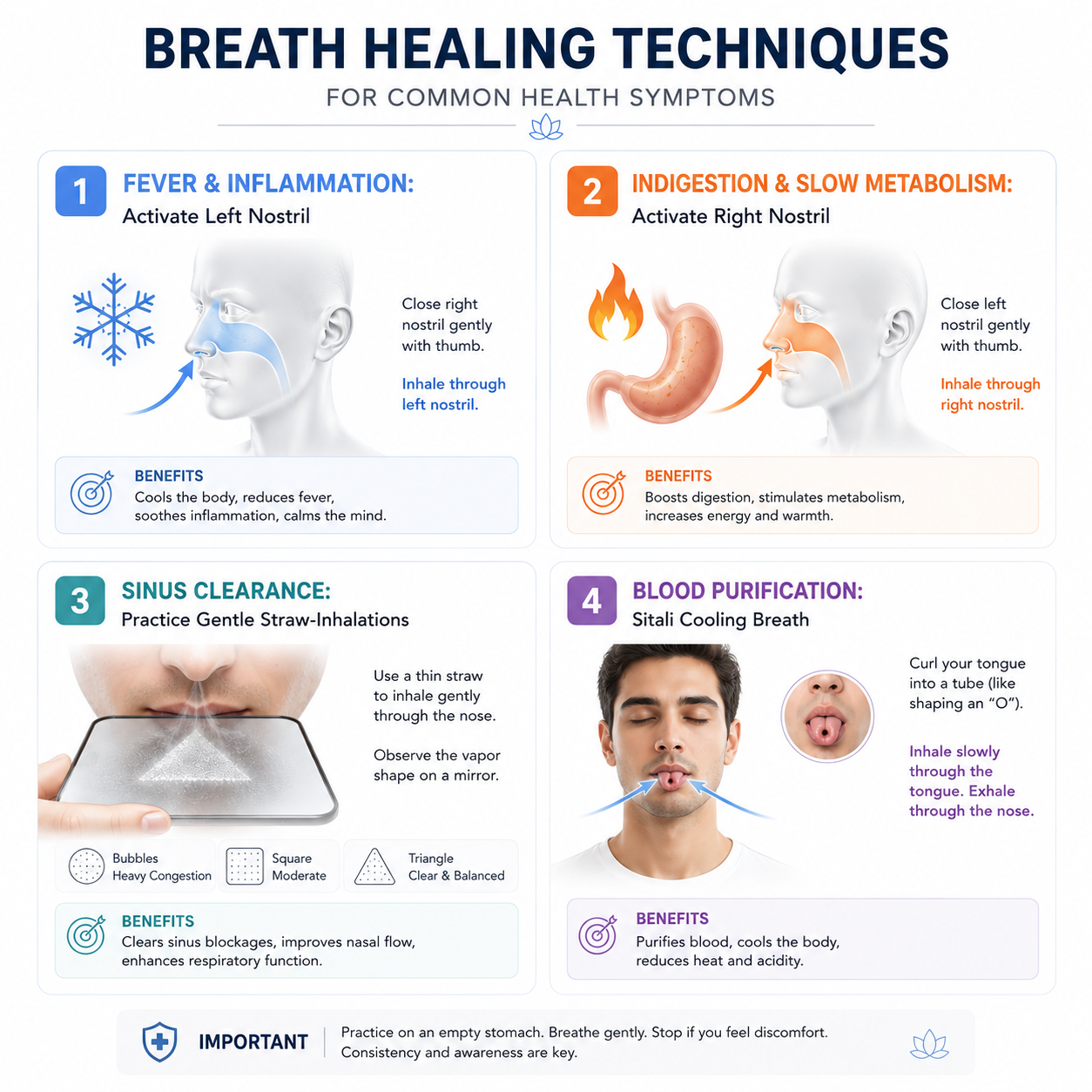
The Swara Remedy Guide: Six Common Conditions
1. Fever (Excess Systemic Heat)
The Diagnosis: Fever is treated as a severe heat condition driven by an over-activation of the solar channel (Pingala) and the Fire element. In most active fever spikes, the right nostril runs completely dominant.
The Intervention: Check your current airflow. If the right side is dominant, gently block it using a clean, small piece of organic cotton to redirect all respiration exclusively through your cooling left nostril. Maintain this left-sided loop while symptoms persist, removing the plug only for meals or bathing. To accelerate relief, recline comfortably onto your right shoulder and visualize a calming, silvery-white moonlight filling your mind’s eye for 5 minutes.
2. Headaches (Sudden & Sun-Induced)
The tradition segments head pain into two distinct operational categories:
- Sudden/General Tension Headache: Take a soft piece of clean cloth or string and wrap it firmly around the upper portion of both elbows simultaneously. Hold this light constriction for 5 to 7 minutes to gently manipulate vascular reflex pathways, releasing the wrap as the localized tension dissipates.
- Sun-Induced Migraine (Half-Kapali): For headaches that begin at dawn and scale in intensity alongside the sun, determine which half of the head holds the pain. Place a small cotton block inside the nostril on that exact same side. This targeted block directly breaks the active localized heat current feeding that hemisphere of the head.
3. Chronic Cold and Sinus Congestion
The Intervention: The moment you wake up in the morning, determine which of your nostrils is naturally more open and dominant. Securely close the opposite, congested side with your thumb. Through that single dominant side, slowly and intentionally “drink” the air. This should feel like drawing liquid smoothly up through a narrow straw, rather than a sharp, sudden sniff. Repeat this slow, drinking inhalation 5 to 7 times sequentially.
Crucial Note: Execute this technique with absolute gentleness. Avoid rushing or forced, aggressive sniffs, which can irritate your delicate nasal lining. Additionally, try to time your warm baths or showers exclusively when your right nostril is leading, as Pingala’s solar energy naturally insulates your respiratory tract against temperature shocks.
4. Indigestion and Sluggish Metabolism
The Diagnosis: Routine bloating and heavy, uncomfortable digestion typically stem from eating while your cooling left nostril (Ida) is leading, meaning your internal metabolic fire is at its baseline minimum.
The Intervention: Check your dominant nostril right before sitting down to eat. If your left side is leading, recline onto your left shoulder for 3 to 5 minutes to mechanically activate your solar right nostril. Consume your meal under this active right-sided dominance. Once finished, lie back down on your left side for 10 to 15 minutes. This post-meal orientation keeps your right channel completely open, maintaining active digestive heat during the critical initial nutrient absorption phase.
5. Systemic Purification: Sitali Kumbhaka
This specialized practice moves into active breath retention to target toxic accumulation, abdominal cramps, and chest tightness. It must be performed exclusively in fresh, clean outdoor air — never in stale, air-conditioned spaces.
The Technique: Curl your tongue into a narrow tube or part your lips slightly to form a small opening. Inhale slowly and deeply through your mouth, drawing the air directly across your wet tongue to create a crisp, cooling sensation. Close your mouth completely, hold the air comfortably inside your chest without straining for 4 to 6 seconds, then exhale slowly and completely through both nostrils. Complete a minimum of 20 consecutive rounds.
6. Eye Strain and Vitality
The tradition outlines an incredibly simple lifestyle integration to ease eye strain. Upon waking or right after finishing a meal, take a clean mouthful of cool water and hold it inside your mouth. While retaining the water, gently splash cold water onto your open eyes 20 to 25 times sequentially. This mechanical process targets ancient cranial-facial reflex loops, revitalizing your optic pathways and relaxing the surrounding musculature.
Your Micro-Habit: The Morning Symptom Check
When to practice: The absolute micro-moment your eyes open to greet the day, before your feet ever make physical contact with the floor.
The baseline trigger: Alarm sounds → you sit up in bed → execute a 10-second horizontal finger check to track your active nostril → ask yourself calmly if any part of your physical body feels heavy or out of balance.
The majority of these simple, targeted interventions require less than five minutes of quiet commitment out of your morning schedule. Traditional texts celebrate this basic practice as the highest form of preventative lifestyle management, systematically optimizing your internal architecture before daily external stressors take hold.
Begin by testing these methods out on minor, everyday challenges — your next unexpected tension headache, an afternoon bout of heavy indigestion, or a congested morning. By shifting your respiratory currents, you will quickly discover that your body’s built-in owner’s manual has been written directly into your breath all along.