Five Elements in the human body : How to Feel them
You’ve probably noticed that some afternoons your digestion is iron-strong and other days a light meal sits in your stomach like a stone. Some mornings your mind is razor-clear. Others, you can’t hold a single thought for more than thirty seconds.
While Western medicine routinely attributes this to general biological variability, ancient Vedic science points to a deeper reality: the shifting balance of the five elements in the human body. This system asserts that you can learn to track, feel, and manage exactly which element is running your physiological machine at any given moment.
This isn’t vague philosophy. It is a highly practical, experiential detection system with a 5,000-year track record of regulating human vitality.
The Five Elements in the Human Body: What Vedic Science Actually Maps
The Panchabhuta framework — translated from Sanskrit as the “five great substances” — holds that everything in the cosmos, including your physical frame, is composed of five elemental principles: Earth (Prithvi), Water (Jala), Fire (Teja), Air (Vayu), and Ether (Akasha).
These are not just metaphors for personality types. In this traditional mapping, understanding the five elements in the human body means looking at specific biological structures, spinal nerve plexuses, and sensory organs. When one element rises in dominance, it directly alters how your nervous system fires, how your mind processes information, and what types of activities you will naturally excel at during that window.
This system connects directly to your chakras — the five foundational energy centers mapped along the spine. Each chakra acts as a neural command post for one specific element. By understanding how these elements interact with your breath, you unlock the practical mechanism behind why specific breathwork and meditation practices shift your physical and psychological states so rapidly.
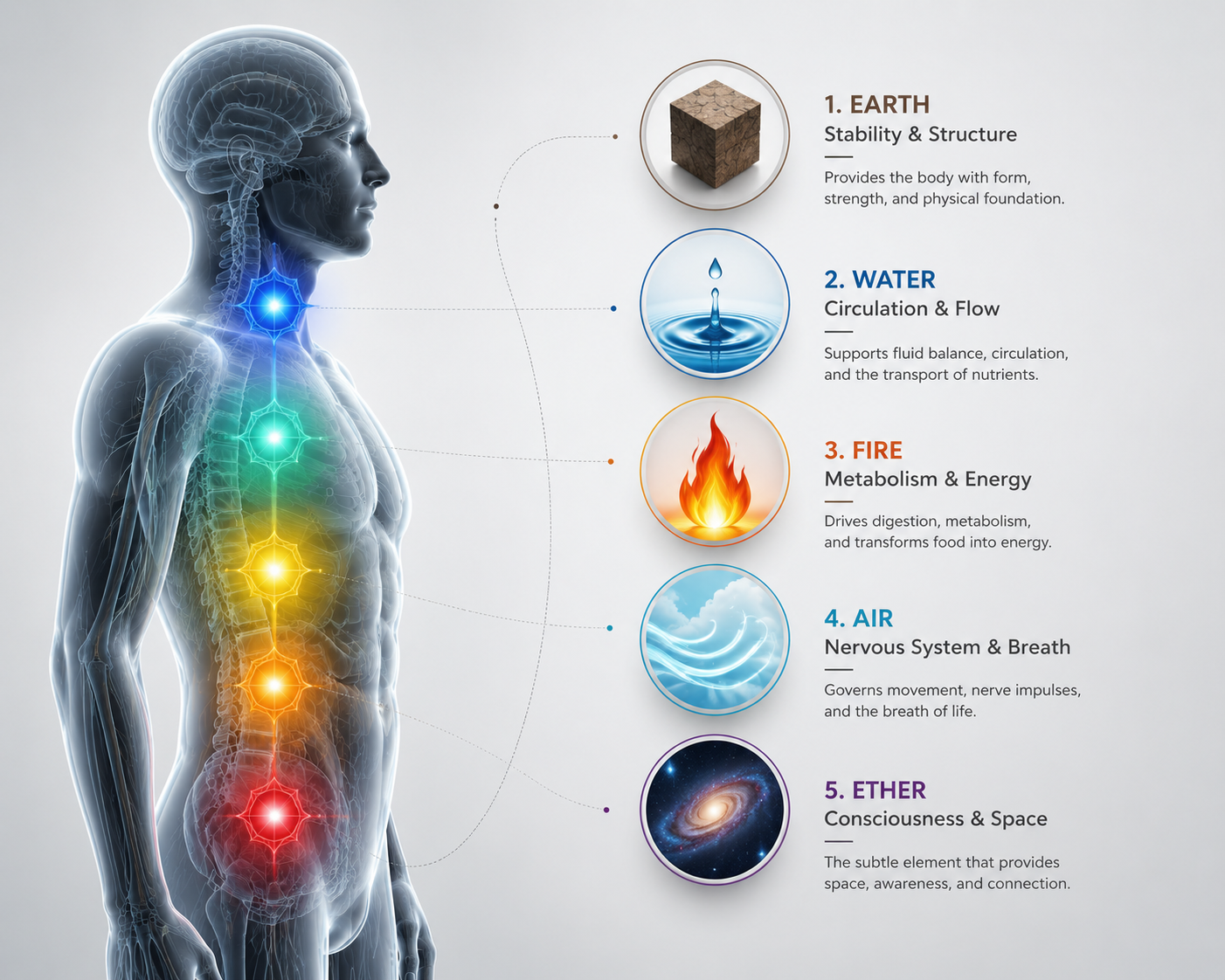
Visualizing how the five subtle elements align with your respiratory flow and physical architecture.
The Five Elements Decoded: Body, Chakra & Function
1. Earth (Prithvi) — The Foundation Layer
Body Correspondence: Bones, nails, skin, hair, and muscles — the dense, structural frameworks of your biology.
Chakra: Muladhara (Adhara Plexus), located at the base of the spine. This is the physiological root where vital energy sits grounded.
Qualities: Stable, heavy, grounding, and associated with a subtle sweet taste. When Earth dominates your breath, you feel deeply rooted, physically resilient, and emotionally content.
The Imbalance: Chronic physical fatigue, a feeling of lethargy, or structural breakdowns in the body. In classical astrology, Mercury governs this element, which is why shifts in its cycles often mirror persistent wellness disruptions.
2. Water (Jala) — The Life Current
Body Correspondence: Blood, plasma, marrow, and all fluid circulatory systems that govern cellular sustenance and growth.
Chakra: Swadhisthana, located near the pelvic plexus.
Qualities: Cool, flowing, cohesive, and vital. When the Water element is dominant, your body retains moisture efficiently, the skin takes on a natural radiance, and your mental state becomes highly collaborative and socially magnetic.
The Imbalance: Fluid retention, emotional volatility, or feelings of stagnation. Ruled by Venus, this element directly impacts your deep sensory desires and feelings of overall harmony.
3. Fire (Teja) — The Transformer
Body Correspondence: Metabolic function, body temperature, digestion, and the cellular processing of nutrients into raw energy.
Chakra: Manipura (Solar Plexus), located near the navel center — your primary metabolic engine.
Qualities: Hot, upward-surging, expanding, and sharp. When Fire runs beautifully through your breath, you feel courageous, highly driven, and fiercely analytical.
The Imbalance: Irritability, acid reflux, systemic inflammation, or sudden mental burnout. Governed by Mars, an uncontrolled fire element frequently shows up as acute physical stress or aggressive energy bursts.
4. Air (Vayu) — The Nervous System Driver
Body Correspondence: Respiratory mechanics and neurological communication — including expansion, contraction, and rapid physical motion. Air masterfully coordinates the entire nervous system.
Chakra: Anahata (Heart Plexus), which physically bridges your lower structural elements with your higher cognitive faculties.
Qualities: Mobile, dry, erratic, and light. When Air is balanced, thoughts move with fluid speed and your physical body feels exceptionally light.
The Imbalance: Anxiety, scattered attention, and nervous exhaustion. Because Saturn rules the Air element, long-term deficiencies here manifest as chronic neurological fatigue or respiratory vulnerabilities.
5. Ether (Akasha) — The Space That Holds Everything
Body Correspondence: The underlying space of consciousness itself. It regulates emotional alchemy: transforming base impulses like anger into forgiveness, and greed into conscious generosity.
Chakra: Vishuddha (Throat Plexus), the ultimate biomechanical center for vocal expression, sound, and spatial resonance.
Qualities: Vast, non-obstructive, all-pervasive, and quiet. Governed by Jupiter — the planetary archetype of wisdom and expansive learning — it provides the space necessary for deep meditation and intuitive breakthroughs.
How to Feel Your Active Element Right Now: A 4-Step Body Scan
You do not need laboratory tools to observe the five elements in the human body. This simple somatic check takes exactly three minutes to complete wherever you are sitting.
Step 1 — Settle the breath (30 seconds)
Sit completely upright with a straight spine. Let your hands rest softly on your knees. Take three deep, unforced, natural breaths. Do not try to modify the rhythm; simply watch the air pass over your upper lip.
Step 2 — Check the dominant nostril (30 seconds)
Gently close your right nostril with your thumb and inhale. Immediately switch, closing your left nostril to breathe through the right. Note which side offers the least physical resistance. A dominant left indicates a cooling, lunar flow; a dominant right indicates a heating, solar flow.
Step 3 — Feel where the air strikes (60 seconds)
Place the smooth back of your hand roughly one inch beneath your nostrils. Exhale slowly and evenly. Feel precisely where the physical stream of air makes contact with your skin:
- Strikes the center of the hand with a steady, mild warmth? → Earth Element is currently leading.
- Flows distinctly downward toward the wrist with a cool sensation? → Water Element is dominant.
- Hits the upper portion of the palm with a sharp, noticeable heat? → Fire Element is burning.
- Disperses sideways across the fingers in a quick, light manner? → Air Element is driving.
- Spreads out softly in all directions across the skin simultaneously? → Ether Element is holding space.
Step 4 — Read the internal color field (60 seconds)
Close your eyes completely. Gently place your warm palms directly over your closed eyelids without applying heavy pressure. Watch the natural colors swirling in your internal vision. A soft yellow tint suggests Earth; a pale white indicates Water; a vibrant red indicates Fire; a deep blue indicates Air; and a multi-colored or rainbow pattern points directly to Ether.
Your Micro-Habit: The After-Lunch Element Check
When to execute: Exactly ten minutes after you finish your midday meal, right as you push your plate away from the table.
The neurological trigger: Setting down your utensils → pausing for one deep chest breath → running the quick 30-second tactile check outlined in Step 3 above.
Midday is a foundational testing window because the Fire element (Teja) should naturally peak here to fuel optimal digestion. If your breath indicates that your metabolic fire is active after eating, your food will break down smoothly and cleanly. However, if you detect an erratic Air dominance (cool, diffuse flow moving across the fingers), you can expect imminent bloating, gas, and poor absorption. Instead of jumping right back to your computer screen, lie down calmly on your left side for ten minutes to mechanically encourage solar, heating dominance.
By anchoring this single habit into your daily routine for a few weeks, your understanding of the five elements in the human body transitions from abstract theory into an active, lived experience. You will stop guessing why your moods fluctuate. Instead, you will read your biology clearly, using your breath as a built-in owner’s manual.