
Left Nostril vs Right Nostril : Which One to breathe Through for Success, Health & Calm
Imagine sitting down for an critical presentation — a high-stakes contract negotiation, a sensitive conversation with a loved one, or an intense career interview. Somewhere right in the middle of it, you feel your biological state working actively against you. Your heart rate quickens, your thoughts scatter, and your vocal tone turns sharper than you ever intended.
What if the specific nostril you were breathing through at that exact micro-moment was either reinforcing your clarity or quietly sabotaging your performance? Understanding the core left nostril vs right nostril breathing benefits is not an overhyped wellness fad; it is an ancient, verifiable framework from the world of Swara Yoga.
By recognizing the unique left nostril vs right nostril breathing benefits, you unlock a systematic method to shift your autonomic state deliberately before stepping into any major event. Here is exactly how this ancient nasal mapping alters your physiology and performance outcomes.
Left Nostril vs Right Nostril Breathing: The Two Energetic Channels
Traditional Swarodaya texts, along with the later Swarakalpa lineages, segregate all respiratory flow into two distinct primary channels. Each channel carries a non-overlapping biological mandate:
- The Left Nostril (Ida Nadi): Governed by lunar energy, this passage delivers a calming, cooling, and restorative impact. When Ida is dominant, your parasympathetic nervous system takes the lead. Cellular repair accelerates, cognitive processes decelerate into clean coherence, and your emotional framework shifts toward receptive connection.
- The Right Nostril (Pingala Nadi): Dominated by solar energy, this passage activates a heating, metabolic, and outward-facing drive. When Pingala stands dominant, your sympathetic nervous system sharpens. Your digestive enzymes fire up, physical physical capacity increases, and your mental state shifts into an execution-oriented action mode.
Modern clinical research on the human nasal cycle consistently verifies that our nostrils alternate dominance roughly every 1 to 3 hours. What Swara Yoga provides is the ultimate operator’s guide for this physiological rhythm — instructing us precisely how to match our external efforts to our current internal state.
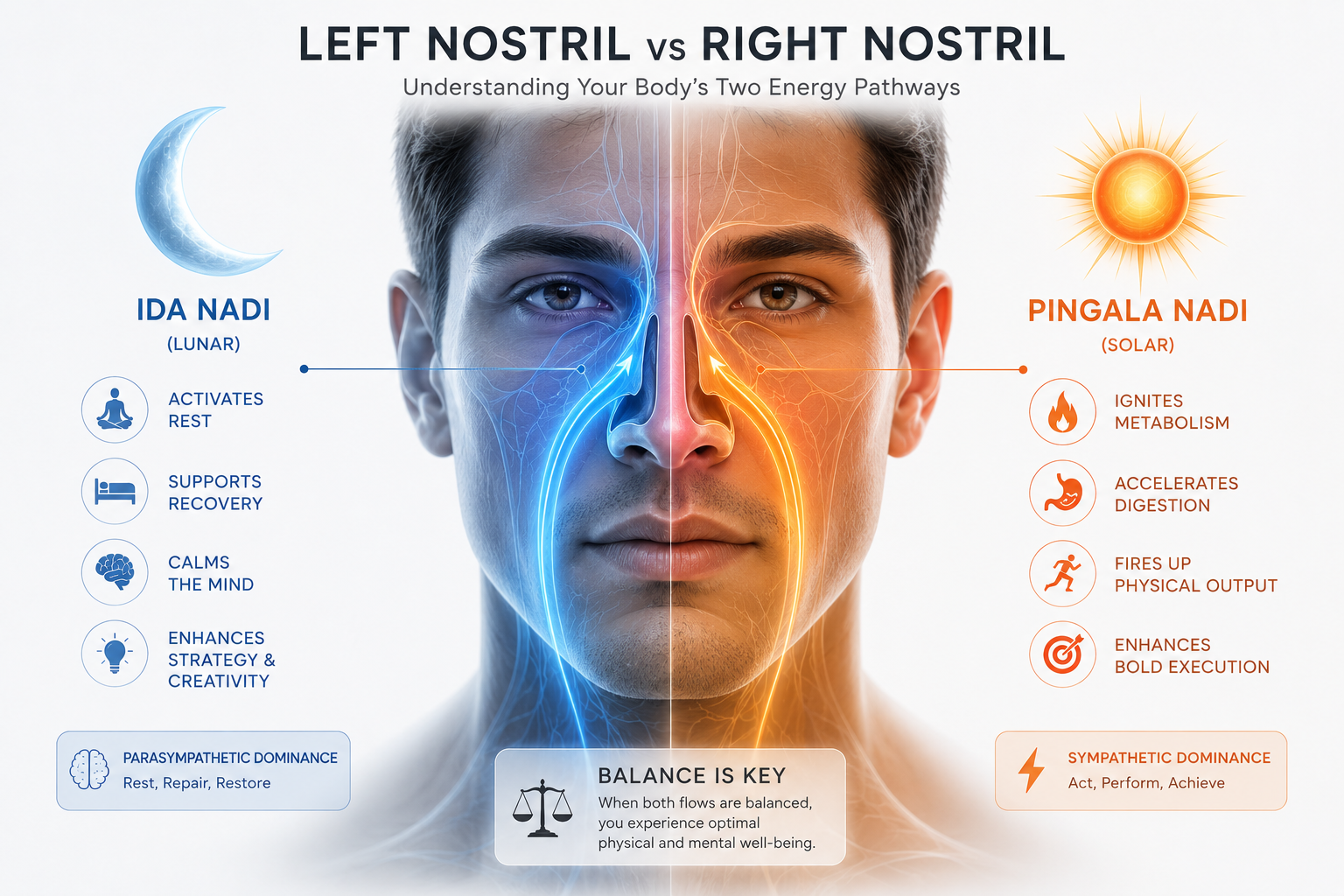
What the Left Nostril (Ida) Is Best For
When your left nostril is flowing freely with minimal physical resistance, the ancient texts outline a highly specific catalog of activities positioned to thrive during this restorative window:
- Long-Term Strategic Endeavors: Architectural planning, long-form creative writing, and designing structures meant to endure.
- Journeys and Travel: Launching travel plans, particularly extensive journeys requiring deep physical and mental stamina.
- Relational and Social Growth: Engaging in collaborative gatherings, resolving interpersonal conflicts, and building trusted professional networks.
- Healing Protocols: Initializing wellness routines, administering or taking medicines, and receiving restorative therapy.
- Financial Stability: Purchasing high-value assets, auditing finances, or executing long-term investment property strategies.
The underlying bioenergetic logic here remains unyielding: Ida serves as the channel of reception, preservation, and foundation. Any task demanding patient focus, spatial depth, or enduring momentum maps perfectly to this lunar window.
What the Right Nostril (Pingala) Is Best For
When your right nostril dictates your primary breathing pattern, your system operates in an accelerated, action-oriented solar configuration. The classical texts specify an entirely contrasting slate of tasks for this high-output window:
- Nutrient Digestion: The active right nostril stimulates metabolic fire; consuming your primary meals during this window optimizes nutrient assimilation and clears digestive sluggishness.
- Intense Physical Labor: Heavy cardiovascular training, athletic performance, and exhausting manual effort.
- Competitive Interventions: Navigating debates, legal proceedings, complex negotiations, or addressing external resistance directly.
- Short-Burst Deliverables: Rapidly clearing items off a checklist that demand uncompromised speed over deep, multi-layered reflection.
The vital takeaway: Pingala energy is forceful, transformative, and transient. Ida energy is structural, expansive, and enduring. A complex commercial deal executed under raw right-nostril dominance might close with rapid velocity, but often requires significant structural revisions down the road compared to an alliance forged under calm left-nostril parameters.
The Middle Path: Sushumna and Why You Should Stop Everything
Beyond the binary options, a third crucial state occurs naturally. During the brief transitional windows where your nasal dominance shifts from one side to the other, both nostrils flow with near-equal capacity. This activates the central energetic highway known as Sushumna Nadi.
The classical texts present an explicit warning here: worldly business efforts routinely fail or yield highly unstable outcomes if initiated while Sushumna is active. This brief phase is decidedly not the moment to finalize high-stakes decisions, sign legally binding documentation, or initiate critical emails.
Conversely, it represents the single most powerful window for deep meditation, intentional mindfulness, and introspective space. In typical conditions, this neutral transition lasts only a few minutes per cycle. If you pause and recognize that both of your nostrils feel perfectly clear and balanced, use that moment to sit in absolute silence before jumping back into the digital fray.
How to Identify Your Dominant Nostril Right Now: A 3-Step Check
You can map your autonomic baseline inside thirty seconds using this simple somatic assessment sequence:
Step 1 — The Finger Airflow Check (10 seconds)
Position your index finger horizontally right under your base of your nose. Exhale cleanly and naturally through your nostrils. Pay close attention to which side produces a firmer, more perceptible stream of air. That current indicates your primary channel.
Step 2 — The Thermal Sensation Validation (10 seconds)
Bring the smooth back of your hand right underneath your nostrils. Exhale once again. The side where the breath feels physically stronger, warmer, or more concentrated confirms your active dominant nadi.
Step 3 — Match Your State to Your Task
Look at your immediate schedule and evaluate if your breath is supporting or hindering you:
- Preparing to eat a substantial meal? You want right nostril dominance. If the left is leading, lie down on your left side for three minutes to manually encourage solar energy.
- Stepping into an emotionally charged conversation? You want left nostril dominance. If the right is blazing, close the right nostril with your thumb and practice slow, isolated left-sided breathing for two minutes.
- About to sign a lasting agreement? Pause and wait for a clear left nostril dominance to ensure systemic calm.
Your Micro-Habit: The Pre-Meal Nostril Check
When to practice: The absolute moment you sit down for your midday or evening meal, before taking your first bite of food.
The daily behavioral trigger: Pulling out your dining chair or placing your meal plate on the table → running the immediate 10-second horizontal finger test before eating.
If your right nostril flows open and clear, proceed with your meal normally; your digestive fire is lit and ready. If your left nostril is leading, spend two brief minutes utilizing a gentle right-nostril isolate breath or lie comfortably on your left side. This mechanical alignment coaxes your system into Pingala dominance, preparing your metabolic environment for efficient breakdown before the first piece of food enters your digestive tract.
The foundational texts are clear that regular right-sided dominance during nutrition optimizes digestive enzymes and systematically alleviates routine stomach discomfort. Chronic issues like occasional bloating or a sluggish metabolism are often simply the result of consuming meals in an unsupportive autonomic state.
Start by anchoring this habit with your lunch routines. Once it feels completely intuitive, scale the tracking to your critical business meetings, creative projects, and high-impact actions. It takes ten seconds, but it provides the highest return on investment in the entire breath management system.